
Hit enter to search or ESC to close
19 August 2025
We know that, according to Faraday's law of electromagnetic induction, the voltage of a transformer winding is directly proportional to the rate of change of magnetic flux: V=N*A .dB/dT. Where V is the winding voltage, N is the number of turns, A is the cross-sectional area of the magnetic core, and dB/dt is the rate of change of magnetic flux density. Under the condition of a constant winding voltage, increasing the switching frequency increases the rate of change over time, thereby increasing the rate of change of magnetic flux density dB/dt. This leads to a reduction in the cross-sectional area of the magnetic core, resulting in a smaller transformer volume. For example, when the frequency is increased from 50 Hz to 100 kHz, the switching frequency is increased by 2,000 times, and the magnetic core cross-sectional area can be reduced to 1/2,000 of the original (in practice, due to material loss limitations, the reduction ratio is typically between 1/50 and 1/200).
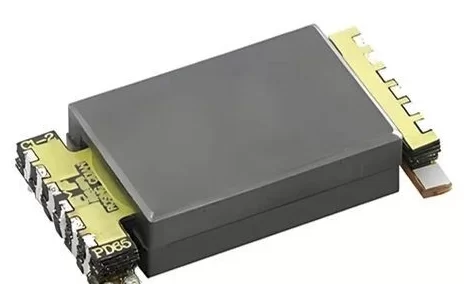
Secondly, as can be seen from the formula, if the magnetic flux density change rate increases while the magnetic core cross-sectional area A remains constant, the magnetization speed accelerates, allowing the number of primary coil turns to be significantly reduced, thereby lowering the winding height and magnetic core window area. These two factors cause the volume of high-frequency transformers to decrease as the switching frequency increases. Compared to power transformers, high-frequency transformers operate in the range of tens of kHz to MHz. Although higher frequencies exacerbate eddy current losses, the use of magnetic materials such as ferrite, which have high resistivity and low eddy current losses, effectively suppresses iron losses.

Additionally, by reducing the volume and number of winding turns, high-frequency transformers shorten the current path, reduce wire resistance, and thereby minimize copper losses. Although the skin effect and proximity effect increase at high frequencies, these can be mitigated by optimizing the winding structure, such as using multi-strand wires or flat wires.
In high-frequency transformers, the balance between iron loss and copper loss enables them to maintain high efficiency. This characteristic becomes more pronounced in switching power supplies as power increases. For example, the efficiency of a 50W switching power supply is generally around 85%, while that of a 500W switching power supply exceeds 92%. Additionally, modern switching power supplies utilize soft-switching techniques (such as ZVS, ZCM) and pulse width modulation (PWM) to enable high-frequency transformers to respond quickly and dynamically, maintaining high efficiency across a wide load range.