The core type transformer stands as a fundamental pillar in the world of electrical engineering, providing the essential mechanism for voltage regulation and power distribution across countless industrial sectors. By utilizing a magnetic core to concentrate flux, these devices ensure that energy is transferred efficiently from one circuit to another, enabling the safe operation of everything from heavy machinery to delicate electronic components. Understanding the nuances of this technology is critical for engineers aiming to optimize energy efficiency and reduce operational costs in modern power grids.
In a global landscape increasingly focused on sustainability and energy security, the role of the core type transformer has evolved. As we shift toward smarter grids and renewable energy integration, the demand for high-performance magnetic components that can withstand varying loads while minimizing heat loss has never been higher. The ability to tailor the core geometry and material composition allows manufacturers to meet stringent international standards for efficiency and safety.
Ultimately, mastering the application of the core type transformer allows businesses to build more resilient infrastructure. Whether it is through reducing harmonic distortion in audio equipment or stabilizing power for industrial automation, the strategic selection of transformer types directly impacts the lifespan and reliability of the entire electronic ecosystem.
Global Relevance of Core Type Transformers
The global demand for reliable power conversion has placed the core type transformer at the center of industrial growth. According to international energy standards and ISO guidelines, the efficiency of power transmission is heavily dependent on the quality of magnetic cores used in distribution. In emerging economies, the rapid urbanization and expansion of electrical grids have led to a surge in the deployment of these transformers to ensure stable electricity delivery to remote regions.
However, the industry faces a persistent challenge: the balance between material cost and energy loss. Many legacy systems suffer from significant "no-load" losses, which, when aggregated across millions of units globally, result in massive energy waste. Addressing these inefficiencies through advanced silicon steel or amorphous metals is not just a technical necessity but a global economic imperative to lower carbon footprints.
Definition and Industrial Significance
In simple terms, a core type transformer is an electrical device where the windings are wrapped around a laminated magnetic core, designed to transfer electrical energy between two or more circuits through electromagnetic induction. Unlike shell type designs, the core type focuses on a structure where the windings surround the core limbs, making it particularly effective for high-voltage applications where insulation is a primary concern.
From an industrial perspective, this design is vital because it allows for easier cooling and more straightforward maintenance. In the context of modern electronic component manufacturing, these transformers are the unsung heroes that step down high voltages to levels safe for sensitive semiconductors, ensuring that the "heartbeat" of a machine remains steady despite fluctuations in the primary power source.
Beyond mere utility, the significance of the core type transformer extends to humanitarian needs, such as providing stable power for medical equipment in underdeveloped areas. By offering a robust and reliable method of voltage conversion, these components ensure that life-saving technology can function regardless of the instability of the local power grid.
Key Technical Factors for Performance
One of the most critical factors in the performance of a core type transformer is magnetic flux density. The ability of the core to channel magnetic fields without saturating determines the maximum power capacity of the unit. High-grade silicon steel is typically employed to minimize hysteresis loss, ensuring that the transformer remains cool and efficient during continuous operation.
Thermal management and durability are equally paramount. Because heat is the primary enemy of insulation, the physical spacing of windings and the choice of cooling medium (oil or air) must be precisely calculated. A well-engineered core type transformer utilizes optimal venting and material selection to prevent thermal runaway, thereby extending the operational lifespan of the device by several decades.
Lastly, scalability and cost-efficiency drive the commercial viability of these components. Manufacturers must balance the use of expensive, high-permeability materials with the structural requirements of the application. By optimizing the core cross-section and winding turns, engineers can create a solution that provides maximum voltage stability while keeping production costs competitive for large-scale industrial rollouts.
Performance Metrics and Comparison
Evaluating the effectiveness of a core type transformer requires looking at specific KPIs such as efficiency ratings, voltage regulation percentages, and thermal dissipation rates. Different core materials, such as Cold-Rolled Grain-Oriented (CRGO) steel versus amorphous metal, yield vastly different results in terms of core loss and weight.
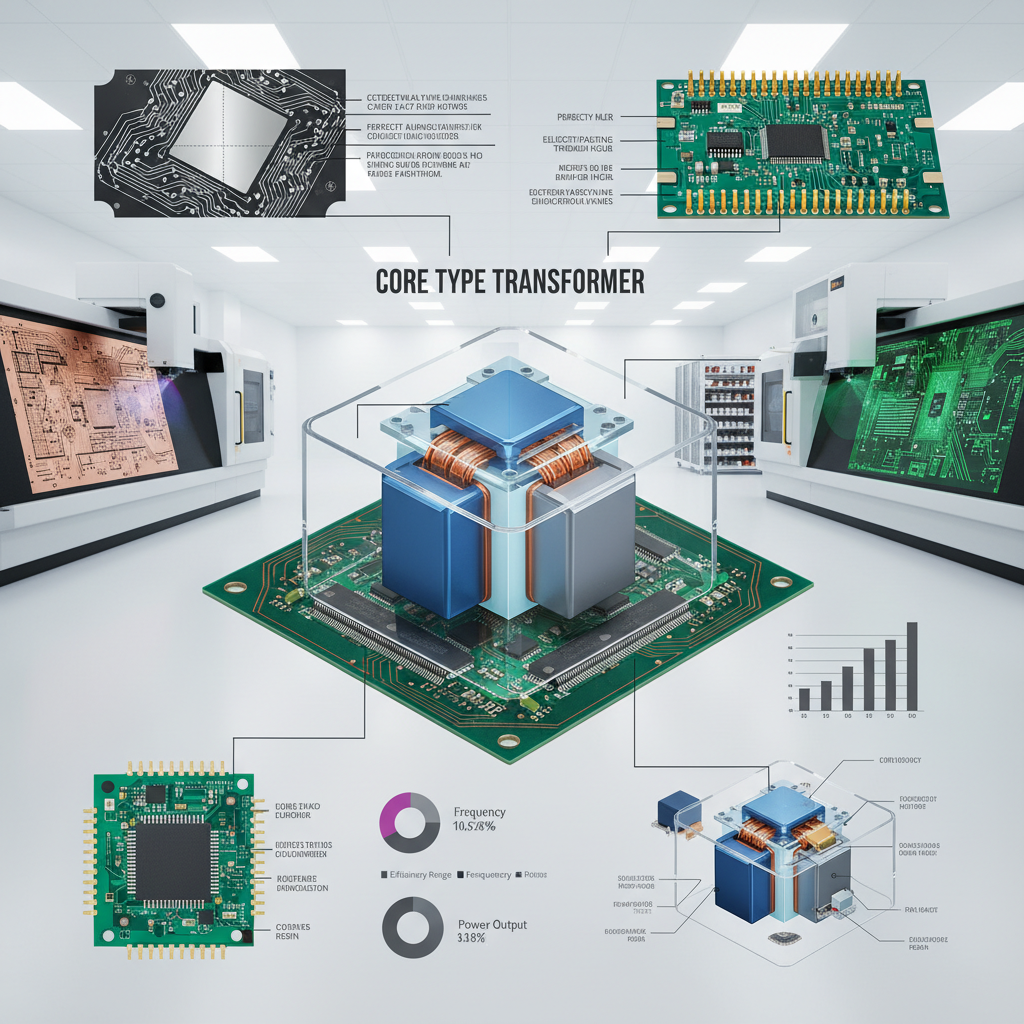
When comparing different design methodologies, it becomes clear that the choice of winding geometry directly affects the parasitic capacitance and overall signal integrity, especially in high-frequency applications. The following chart illustrates how different core configurations perform across key industry benchmarks.
Core Type Transformer Performance Benchmark
Real-World Global Applications
The application of the core type transformer is ubiquitous. In heavy industrial zones, such as the automotive manufacturing hubs in Germany and Japan, these transformers are used to step down medium voltage for robotic assembly lines, ensuring that precise movements are not interrupted by voltage sags. Their robustness makes them ideal for environments with high vibration and temperature swings.
In the realm of high-fidelity audio, specialized core type designs are used in crossover networks and power supplies for amplifiers to eliminate hum and noise. By carefully controlling the magnetic leakage, these components preserve the purity of the audio signal, providing the "clean" power required for professional studio equipment and high-end home cinema systems across North America and Europe.
Long-Term Value and Sustainability
Investing in a high-quality core type transformer provides tangible long-term value by significantly reducing the Total Cost of Ownership (TCO). While the initial procurement cost of an ultra-efficient transformer may be higher, the reduction in monthly energy losses and the decrease in cooling requirements lead to a rapid return on investment (ROI), often within just a few years of operation.
From a sustainability perspective, the transition to eco-friendly core materials reduces the reliance on rare earth metals and decreases the carbon footprint associated with power distribution. The reliability of these units also reduces electronic waste, as a well-built transformer can last for 30 to 50 years, contrasting sharply with the "planned obsolescence" seen in smaller electronic gadgets.
Beyond the logic of cost and carbon, there is an emotional angle of trust and safety. Knowing that a facility's power is managed by a stable, high-capacity transformer provides peace of mind to plant managers and operators, ensuring that critical safety systems remain active and that production quotas are met without unexpected downtime.
Future Trends and Innovation Paths
The future of the core type transformer is being shaped by the digital transformation of the energy sector. We are seeing the rise of "Smart Transformers" integrated with IoT sensors that can monitor temperature and load in real-time. This allows for predictive maintenance, where a transformer can signal for a check-up before a failure occurs, eliminating catastrophic blackouts.
Furthermore, innovations in nano-crystalline materials are pushing the boundaries of efficiency. These materials offer significantly lower core losses than traditional silicon steel, allowing for the design of smaller, lighter transformers that do not sacrifice power capacity. This is particularly critical for the aerospace and electric vehicle (EV) industries, where weight reduction is a primary goal.
As green energy policies accelerate worldwide, the integration of these transformers into DC microgrids and renewable energy hubs will become standard. The shift toward a decentralized power grid will require more versatile and modular core type designs that can handle the bidirectional flow of energy from residential solar panels back into the main grid.
Comparative Analysis of Core Type Transformer Technology Evolution
| Technology Generation |
Core Material |
Efficiency Level |
Primary Use Case |
| Legacy Series |
Standard Silicon Steel |
Moderate (70-85%) |
Basic Power Distribution |
| Industrial Pro |
CRGO Steel |
High (85-95%) |
Factory Automation |
| Eco-Efficient |
Amorphous Metal |
Very High (95-98%) |
Smart City Grids |
| Ultra-Compact |
Ferrite / MnZn |
Application Specific |
Switching Power Supplies |
| Next-Gen Alpha |
Nano-crystalline |
Ultra High (98%+) |
EV & Aerospace |
| Smart Integrated |
Composite Magnetic |
Dynamic Optimization |
IoT Energy Hubs |
FAQS
The primary difference lies in the construction. In a core type transformer, the windings surround the core limbs, providing better insulation and easier cooling for high-voltage needs. In contrast, a shell type transformer has the core surrounding the windings, which offers better mechanical protection and is often used for lower voltage, higher current applications. The core type is generally preferred for its scalability and maintainability in large power distributions.
Reducing energy loss involves two main strategies: minimizing hysteresis and eddy current losses. Upgrading to amorphous metal cores or high-grade Cold-Rolled Grain-Oriented (CRGO) steel can significantly lower no-load losses. Additionally, ensuring that the laminations are properly insulated and the core is tightly clamped prevents vibration and heat buildup, which further improves efficiency and overall performance.
While traditional iron-core transformers are designed for low frequencies (50-60Hz), core type designs utilizing ferrite or powder cores are ideal for high-frequency applications. These materials prevent the massive eddy current losses that would occur in silicon steel at high frequencies. These are commonly found in switching power supplies and high-frequency induction heating equipment.
With proper maintenance and environmental control, an industrial-grade core type transformer can last between 30 and 50 years. The primary factors affecting longevity are thermal stress and insulation degradation. Implementing a regular oil analysis (for oil-cooled types) and ensuring adequate ventilation can prevent premature aging and avoid costly unplanned downtime.
Core material is one of the most significant cost drivers. Standard silicon steel is the most affordable. Amorphous metals and nano-crystalline materials are more expensive to produce due to complex manufacturing processes (such as rapid cooling). However, the higher initial cost is offset by the dramatic reduction in electricity costs over the unit's lifetime, making the high-end materials more cost-effective in the long run.
Yes, especially for audio or medical applications. Noise in transformers is usually caused by magnetostriction (the core expanding and contracting). By using high-quality core laminations, implementing vibration-damping mounts, and employing electrostatic shielding, manufacturers can create "ultra-quiet" core type transformers that meet strict electromagnetic interference (EMI) and acoustic standards.
Conclusion
The core type transformer remains an indispensable component of the global electrical infrastructure, bridging the gap between high-voltage generation and precise electronic consumption. By balancing material science, thermal engineering, and geometric optimization, these devices ensure that power is delivered safely and efficiently across a vast array of industries, from heavy manufacturing to high-fidelity audio.
Looking forward, the integration of smart monitoring and the adoption of nano-crystalline materials will redefine the boundaries of efficiency and reliability. For businesses seeking to future-proof their operations, investing in high-efficiency magnetic solutions is not just a technical upgrade—it is a strategic commitment to sustainability and operational excellence. Visit our website for professional solutions: www.xcdmagnetic.com