
Hit enter to search or ESC to close
30 December 2025
In the intricate landscape of automotive electronic systems, electromagnetic interference (EMI) is a persistent threat that can disrupt signal transmission, damage sensitive components, and compromise overall vehicle safety. To address this challenge, automotive common mode choke and common mode choke devices have become indispensable, with common mode choke coils serving as their core functional components. Xinchangda, a professional OEM & ODM manufacturer of transformers, inductors, and crossovers with 14 years of industry experience in China, specializes in designing and producing high-performance automotive common mode choke products tailored to the rigorous demands of automotive applications. Boasting a 5000㎡ production facility, 50 skilled workers, 10 R&D engineers, 14 fully automated and 6 semi-automated production lines, the company achieves a monthly capacity of 450k transformers, 240k inductors, and 100,000 crossover networks. Committed to delivering one-stop magnetic component solutions for audio, medical, new energy, and industrial sectors, Xinchangda prides itself on manufacturing customized and challenging parts, aiming to be the optimal partner for global clients.
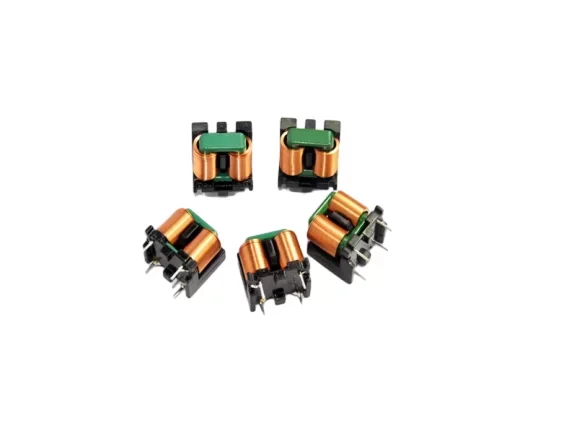
The performance of automotive common mode choke is directly determined by the quality of common mode choke coils, making material selection a foundational step in common mode choke design. Automotive environments are characterized by extreme temperature fluctuations, constant vibration, and high humidity, so materials for common mode choke coils must meet strict durability and electrical performance standards.
Copper wire is the primary conductor material for common mode choke coils due to its excellent electrical conductivity, which minimizes power loss during operation. For high-temperature automotive scenarios, Xinchangda uses enameled copper wires with polyimide insulation layers, which can withstand temperatures ranging from -40°C to 150°C, preventing insulation breakdown and short circuits. In compact automotive common mode choke designs, wire is adopted—this wire consists of multiple insulated strands twisted together, effectively reducing skin effect and proximity effect losses at high frequencies, which is crucial for suppressing EMI in electric vehicle (EV) powertrain systems and infotainment modules.
Matching the right magnetic core with common mode choke coils is equally vital. Ferrite cores are the top choice for common mode choke in automotive applications, thanks to their high magnetic permeability and low eddy current loss. Nickel-zinc ferrite cores are ideal for high-frequency EMI suppression (1 MHz–1 GHz), targeting interference from automotive ECUs and sensors. Manganese-zinc ferrite cores, with higher saturation flux density, are suitable for high-current scenarios like battery management systems. Xinchangda’s R&D team conducts rigorous material testing, simulating real automotive operating conditions to select the best coil-core combinations, ensuring each automotive common mode choke delivers stable performance.
As automotive electronic systems trend toward miniaturization and integration, structural optimization of automotive common mode choke has become a key focus of common mode choke design, balancing compactness and performance.
The core of structural design lies in the symmetrical winding of common mode choke coils. A standard common mode choke features two identical common mode choke coils wound symmetrically around a magnetic core. This symmetry ensures that differential mode currents (normal working currents) cancel out each other’s magnetic fields, passing through with minimal impedance, while common mode currents (interference currents) generate a cumulative magnetic field, which is attenuated by the core’s high impedance. Xinchangda’s engineers refine this symmetry with precision winding techniques, controlling the number of turns, winding pitch, and layer arrangement of common mode choke coils to maximize common mode impedance and minimize differential mode loss. For compact applications, interleaved winding is used to shorten coil length, reducing parasitic capacitance and improving high-frequency performance.
Mechanical robustness is another critical aspect of structural optimization. Automotive components endure constant road vibration, so automotive common mode choke designs incorporate epoxy resin encapsulation. This process secures common mode choke coils and cores in place, enhances insulation, and resists corrosion, extending the product’s service life. Additionally, optimized terminal designs ensure reliable PCB soldering, reducing the risk of connection failures caused by vibration.
Rigorous performance testing is essential to ensure automotive common mode choke products meet automotive industry standards, with a focus on common mode choke coils performance under real operating conditions.
The key performance indicator is common mode impedance. Xinchangda’s testing lab uses network analyzers to measure the impedance of common mode choke coils across a frequency range of 10 kHz to 1 GHz, ensuring high impedance at target interference frequencies. Tests are also conducted under extreme temperatures to verify impedance stability, preventing EMI suppression failure due to temperature-induced core permeability changes.
Mechanical testing is equally important. Vibration tests simulate 1000 hours of road conditions to check for coil displacement or core damage. Thermal shock tests cycle products between -40°C and 125°C to assess insulation durability. Only products passing all tests are approved for delivery, reflecting Xinchangda’s commitment to quality.
Automotive common mode choke offers three core advantages. First, high-efficiency EMI suppression filters interference from motors, inverters, and ECUs, ensuring stable operation of navigation and sensor systems. Second, excellent temperature stability allows operation in extreme automotive environments without performance degradation. Third, customizable design—Xinchangda adjusts common mode choke coils winding parameters and core materials to meet specific impedance and size requirements for traditional and electric vehicles, making it a versatile solution.
Selecting common mode choke coils requires three considerations: frequency range, current rating, and installation space. Match coil impedance to target interference frequency—NiZn ferrite cores for high-frequency EMI, MnZn for low-frequency scenarios. Ensure the coil’s current rating exceeds the circuit’s maximum differential mode current to avoid saturation. For compact systems, choose litz wire coils with precision winding. Xinchangda’s team provides free technical consultation to help clients select the optimal coils.
Yes, automotive common mode choke customization is one of Xinchangda’s core strengths. Whether clients need specific impedance values, compact sizes, high-temperature resistance, or special terminals, the R&D team adjusts common mode choke coils parameters, core materials, and structural designs to deliver tailored solutions. Rapid prototyping services produce samples in 7–10 days for testing, ensuring the final product aligns with application needs.
Common mode choke performance is affected by three key factors. First, common mode choke coils material and winding—high-conductivity copper reduces loss, while symmetrical winding ensures EMI suppression efficiency. Second, core material—ferrite cores with high permeability enhance performance but may saturate under high currents. Third, operating environment—extreme temperatures and vibration can damage coil insulation and cores. Xinchangda uses premium materials and strict manufacturing processes to mitigate these risks.
Choosing Xinchangda for common mode choke and automotive common mode choke relies on three strengths. 14 years of expertise in magnetic component design ensures mastery of common mode choke coils optimization. Advanced production lines enable high-volume output with timely delivery for both small and large orders. One-stop solutions cover design, prototyping, production, and after-sales service, eliminating supplier coordination hassle. Xinchangda is dedicated to becoming your trusted partner for all common mode choke needs.
In the evolving landscape of automotive electronics, the design of automotive common mode choke directly impacts vehicle electronic system stability, safety, and EMI suppression capabilities. Xinchangda, with 14 years of professional experience, has refined every link of common mode choke development—from the material selection and structural optimization of common mode choke coils to rigorous performance testing—delivering high-quality, customizable solutions that adapt to extreme automotive environments. Its one-stop OEM & ODM services, backed by advanced production lines and a professional R&D team, ensure that each automotive common mode choke meets the unique needs of diverse applications, from traditional vehicles to new energy models. As automotive electronics become more integrated and intelligent, Xinchangda will continue to innovate in common mode choke design, adhering to strict quality standards and customer-centric principles, to provide reliable magnetic component support for global clients and grow together as a trusted long-term partner in the automotive industry.